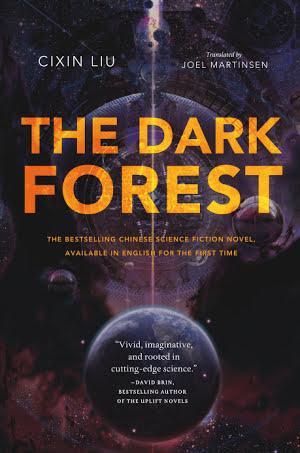
The Dark Forest (Chinese: 黑暗森林) is a 2008 science fiction novel by the Chinese writer Liu Cixin. It is the sequel to the Hugo Award-winning novel The Three-Body Problem in the trilogy titled "Remembrance of Earth's Past", but Chinese readers generally refer to the series by the title of the first novel. The English version, translated by Joel Martinsen, was published in 2015. The novel's title comes from the dark forest hypothesis, coined by Liu in the novel, but described by astronomer and author David Brin as early as 1983 …
The Dark Forest (Chinese: 黑暗森林) is a 2008 science fiction novel by the Chinese writer Liu Cixin. It is the sequel to the Hugo Award-winning novel The Three-Body Problem in the trilogy titled "Remembrance of Earth's Past", but Chinese readers generally refer to the series by the title of the first novel. The English version, translated by Joel Martinsen, was published in 2015. The novel's title comes from the dark forest hypothesis, coined by Liu in the novel, but described by astronomer and author David Brin as early as 1983 as a possible solution to the Fermi paradox.
Very entertaining book, with a poor Spanish translation
3,0 stars
I really enjoyed this book. I think it is a great sequel which rapidly advances on the plot from the first entry of the Three Body Problem trilogy.
I wasn't hooked to it for the most part except for a few chapters in its latter half, where I found myself unable to put the book away.
Its Spanish translation is mediocre at best. It does the job of translating the original text, but the writing is confusing at times and the occasional typo shows up.
I would recommend this book to anyone who enjoyed the first one and is not afraid to keep up with all the Chinese names that are not common for us westners
El bosque oscuro, Liu Cixin (Lurraren iraganaren oroitzapena (Hiru gorputzak); 2)
4,0 stars
Advertencia de contenido
Kontuz izenburuaren azalpenarekin ez baduzu liburua irakurri
"Lurraren iraganaren oroitzapena" (edo "'Hiru gorputzak' ezagunagoa den) trilogiaren bigarren alea. Bigarren eskuko azoka batean ikusi nituen eta lehenagotik zekarten famagatik hartu. Harrituta itzi ninduan lehenengoak ez nuelako horrelako istoriorik espero baina denboralditxo bat pasa da bigarren hau irakurri dudanera arte (ea azkenengoa den hurrengorako ez dudan hainbesteko tarterik uzten. Gero eta liburu meheagoen zale bihurtzen ari naiz).
Hau ere oso ondo dago baina lehenengoaren sorpresa efektua galdurik 'arruntagoa' iruditu zait.
Gehien gustatu zaidana, agian izenburuaren azalpena (adi hemendik aurrera) Unibertso osoa baso ilun bat bezala irudikatzen du, non aurrerapen-maila ezberdina garatu duten zibilizazioak ehiztari ixilen antzera dabiltzaten bere burua agerian utziko duen hurrengo harrapakinaren esperoan. Ikuspuntu ilun honek irakurlea erabat astinduko du 'Gizadia' zein aurrerapen mailara heldu daitekeen (Doctorowen "Walkaway"n agertzen zena baina onean gogorarazi dit) erakusten baitio eta gero zartakoa eman.
The book's premise is fascinating, it tackles quetions about life, cooperation and conflict. But I agree with kab, the author writes misogynisticly with very objectified female characters.
Qué lástima más grande que un libro con un final tan cojonudo y una narrativa que enganche esté plagado de tal ranciedad, tal misoginia y tal homofobia que te amargue todo el viaje.
El problema que tiene Liu con las mujeres no es ni medio normal. No es que sean un 0 a la izquierda en sus novelas si no que, cuando aparecen, son seres de luz delicados, inocentes, de risa angelical y -transcribo literalmente- inteligente pero no tanto como para llegar al esnobismo.
Cuando no lidias con el secuestro de mujeres por los caprichos de un niño-hombre tienes la condescencia que Liu dedica a los milennials: aniñados, sensibleros, incapaces de lidiar con una crisis, analfabetos emocionales... Suerte que está su generación para salvar a la humanidad, porque está claro que, según él, las nuevas no están a la altura.
Y ya cuando crees que la cosa no puede ir …
Qué lástima más grande que un libro con un final tan cojonudo y una narrativa que enganche esté plagado de tal ranciedad, tal misoginia y tal homofobia que te amargue todo el viaje.
El problema que tiene Liu con las mujeres no es ni medio normal. No es que sean un 0 a la izquierda en sus novelas si no que, cuando aparecen, son seres de luz delicados, inocentes, de risa angelical y -transcribo literalmente- inteligente pero no tanto como para llegar al esnobismo.
Cuando no lidias con el secuestro de mujeres por los caprichos de un niño-hombre tienes la condescencia que Liu dedica a los milennials: aniñados, sensibleros, incapaces de lidiar con una crisis, analfabetos emocionales... Suerte que está su generación para salvar a la humanidad, porque está claro que, según él, las nuevas no están a la altura.
Y ya cuando crees que la cosa no puede ir peor dedica un párrafo maravilloso para hablar del acto más inmundo y depravado al que la humanidad se desboca en el momento de mayor crisis. Algo tan aborrecible que los dos protagonistas tuercen el gesto de horror: Una orgía pública. Peor aún, una orgía pública dónde heterosexuales y homosexuales se mezclan y, dios mío, igual hay gente teniendo orgasmos.
Le reconozco a Liu la mejora en la narrativa: las encrucijadas morales de los hombres protagonistas son interesantes, algunas escenas fascinantes y un final redondo y perfecto. Pero no podría recomendar este libro sin avisar antes del profundo asco que te puede provocar el autor.