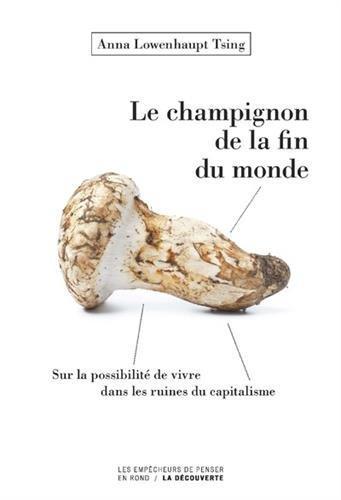
The Mushroom at the End of the World: On the Possibility of Life in Capitalist Ruins is a 2015 book by the Chinese American anthropologist Anna Lowenhaupt Tsing. The book describes and analyzes the globalized commodity chains of matsutake mushrooms.
Un viaggio tra i popoli e le culture sviluppatisi intorno ai matsutake, dei funghi che prosperano tra le rovine umane. Un immaginario estremamente affascinante che però si contrappone a un costante e inesorabile calo di incisività.
Resta tremendamente affascinante, seppur già vista in testi più incisivi, la critica alla visione individualista della biologia che ha dominato la storia recente.
[ESP] El principal problema que le veo al libro, más allá de que se pone un poco fantasioso en ciertas partes es la escritura. En ciertas partes se me hace muy académico - o sea, excesivamente complejo para lo que quiere contar - y en otras ell uso del matsutake como ejemplo signular de la realidad capitalista, me aporta poco. Tiene partes muy interesantes, como la parte en que habla de los ordenes espontáneos en la naturaleza, pero en general, me parece que podría haber sido mejor enfocado de otra manera.
[ENG] The main problem I see in the book is, more so than the somewhat fastastic outlook it provides in certain parts, the writing. Certain parts are overly academic - meaning excesively complex for what it wants to convey- and in other parts the use of matsutake as a particular example of the reality and workings of capitalism, …
[ESP] El principal problema que le veo al libro, más allá de que se pone un poco fantasioso en ciertas partes es la escritura. En ciertas partes se me hace muy académico - o sea, excesivamente complejo para lo que quiere contar - y en otras ell uso del matsutake como ejemplo signular de la realidad capitalista, me aporta poco.
Tiene partes muy interesantes, como la parte en que habla de los ordenes espontáneos en la naturaleza, pero en general, me parece que podría haber sido mejor enfocado de otra manera.
[ENG] The main problem I see in the book is, more so than the somewhat fastastic outlook it provides in certain parts, the writing. Certain parts are overly academic - meaning excesively complex for what it wants to convey- and in other parts the use of matsutake as a particular example of the reality and workings of capitalism, didn't convey that much.
There are very interesting parts, like the one where shel talks about spontaneous order in nature but, in general, I feel that another approach when writing the book would have benefited it.